Showing posts with label duty to God. Show all posts

Saturday, September 24, 2022

September campout has Scouts climbing the walls…literally

When the troop heads to North Alabama, it’s usually to conquer the rocky trails and mountainous paths of the Pinhoti Trail. The troop headed north the weekend of Sept. 10-11 to take on a different challenge.
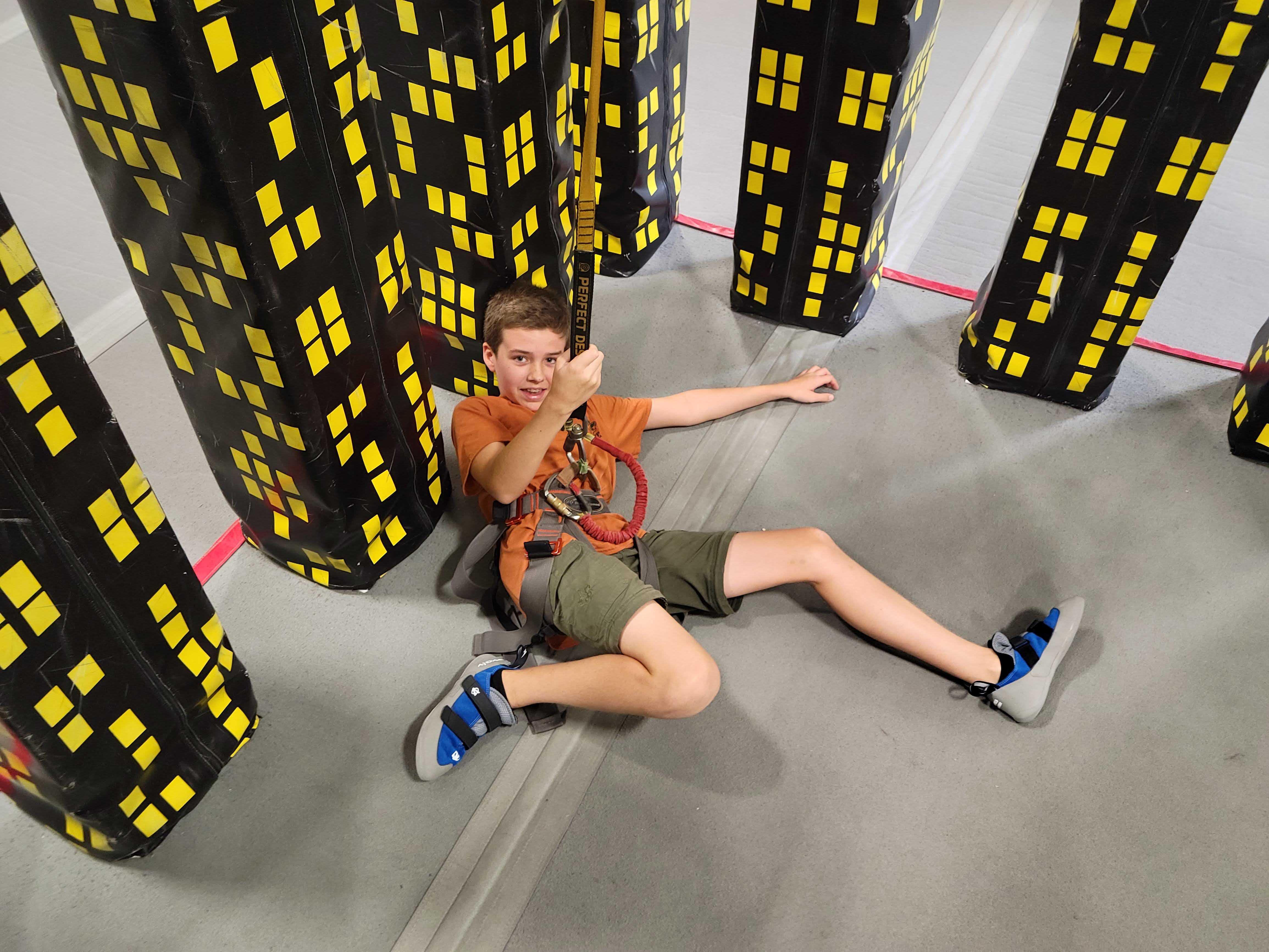

Will goes splat!
After a quick trip to Oak Mountain State Park to set up dining flies, the troop headed to High Point Climbing and Fitness. The facility offers rock walls of varying skill levels. After strapping into safety harnesses and donning their special rock-climbing shoes (think bowling shoes but for climbing), some Scouts headed straight to the higher-difficulty options. Others (including many of the leaders) tested their skills in the kids’ area. As confidence levels increased, everyone took to medium- and high-difficulty options. Of course, friendly competitions and time trials ensued, which pitted Scout against Scout, and on occasion, Scout against adult leader. And, everyone agreed that the sensation of free falling was something that took a while to get used to.

Amazing Spidermen Jackson (left) and Jacob (right)

Parker, the troop's newest Scout, masters tent-pitching.

The troop returned to their Oak Mountain State Park campsite late in the afternoon to resume setting up camp—including setting up tents and stowing gear. Scouts and leaders convened around a Mexican fajita dinner. After eating and relaxing, Scouts and leaders took their sore muscles to bed.

On Sunday, Scouts awoke to ham, egg and cheese bagels, followed by a quick takedown of tents and other campsite gear. That provided the troop time for a 1.4-mile hike on the park’s North Trailhead. The group took a mid-hike pause for its traditional Sunday morning Scouts’ Own devotional service. As the troop’s chaplain, Assistant Scoutmaster Michael Tullier led the group in a discussion of how physical challenges like rock wall climbing and mountain trail hikes can remind us of the uphill challenges we face in our personal and spiritual journeys. The group pondered how verses like 2 Corinthians 4:17 and 12:9-10, James 1:2-3 and Romans 5:3-4 relate to the troubles and trials in our lives, as well as the important role of grace and perseverance.

In its post-campout Patrol Leaders Council meeting the following Monday, the troop’s youth leadership agreed the rock-wall climbing activity was great that the troop should do again in the future. From setting up camp Saturday morning to duty assignments throughout the weekend and packing up on Sunday, Scouts worked together and seamlessly. Scouts enjoyed eating together as a troop (and having Assistant Scoutmaster Michael Tullier manning the kitchen. They even enjoyed Sunday’s impromptu hiking excursion.

The troop’s next monthly outing with be the Saugahatchee District Camporee, which has been rescheduled to Oct. 7-9 (the troop was originally scheduled to camp the weekend of Oct. 21). The campout will take place at Auburn's Chewacla State Park.

For more pictures from the campout, visit the troop’s online photo album.


Wednesday, November 10, 2021

Paying tribute to the victims of war


The troop left Auburn on Saturday, Nov. 6 for a two-day campout and visit to the Andersonville National Historic Site in Andersonville, Georgia. The site, managed by the National Park Service, gives visitors a glimpse into the plight of prisoners of war—especially those Civil War Union soldiers detained behind enemy lines by the Confederate Army. The visit coincided with the nation’s annual Veterans Day observance on Nov. 11.

Jake, Jackson and Connor view some of the Prisoner of War
Museum artifacts.
The Andersonville National Historic Site includes several historic properties: the National Prisoner of War Museum; the site of Camp Sumter, the most infamous of Civil War-era Confederate prisons; and the Andersonville National Cemetery. The park’s historic trail questionnaire helped guide the contingent's journey through Civil War history by challenging Scouts to glean facts from displays and kiosks throughout the site.

The troop began its walking tour at the National Prisoner of War Museum, which since opening in 1998, has told the story of POWs throughout American history. Visitors are met with an exhibit answering the question “What is a POW?” Hands-on and multimedia displays following that introduction explore themes of capture, living conditions, news and communications, morale and relationships, and escape and freedom.


The next stop on the historic hike was the site of Camp Sumter, also known as Andersonville Prison. The historic prison site is comprised by 26.5 acres outlined with double rows of white posts to indicate the location of the original prison walls. Two sections of the stockade wall have been reconstructed—the north gate and the northeast corner. In walking the grounds, Scouts and leaders learned more about the living conditions faced by those imprisoned there, their efforts to escape, and by browsing the various monuments on the property, the number of Union POWs who lost their lives as war prisoners.

Teams pitted themselves against each other to come up with the most creative—
and impervious—POW lean-to.

After lunch, the troop returned to the stockade area, where in service to the park, they constructed prisoner-style lean-to structures using some of the same materials that would have been available to Union POWs of the day. These shelters would have been what POWs called home and where they would have sought refuge from the sweltering Georgia sun and heat, as well as rain and cold. The troop divided into thirds to put their creativity to the test—along with their construction and knot-tying skills.


The troop gathered at the cemetery's "Georgia Monument,"
dedicated on Memorial Day 1976 to honor all American POWs.
Following their shelter-building efforts, the troop resumed its historic fact-finding hike in the Andersonville National Cemetery. Initial interments, beginning in February 1864, were trench burials of the prisoners who died in the nearby military prison. Today the cemetery contains nearly 20,000 interments—including the nearly 13,000 soldiers who died during their imprisonment at Camp Sumter. The cemetery is one of 14 administered by the National Park Service and remains open and active for burials. Scouts took an interest in the variety of symbols used on headstones to represent religious beliefs and personal philosophies.

The troop returned to its campsite (they made a brief stop upon their arrival in Andersonville to set up camp and personal tents) to ready for dinner. It’s always a great time when we can celebrate special occasions and milestones during campouts. This campout, the Leadership Corps helped Jackson’s 14th birthday with a hearty helping of cherry cobbler (complete with whipped cream, of course!). Following dinner, some of the troop gathered around a roaring campfire, while others headed to bed to insulate themselves for the evening temps in the 40s (and the extra hour of sleep the change in Daylight Savings Time promised).

Patrol Leader Beck mastering the camp oven as part of
Sunday's breakfast prep.
Sunday’s devotional program, led by assistant scoutmaster and chaplain Michael Tullier, centered on mission statements—especially the troop’s, which ascribes to “gather young men into a quality Scouting program, grow them into servant leaders, and go into the community in service and fellowship.” Scouts and leaders focused on personal and biblical perspectives of “servant leadership” and how the troop fulfills it through its activities, service projects and personal activities.

At part of its post-campout critique, the troop's Patrol Leaders Council the following Monday classified the campout as “smooth” and “well-run.” They liked the campout’s educational aspects, complimented Scouts on their quick campsite setup, and overall good menu-planning and preparation. They did note a lacking depth of patrol leadership, but especially credited Wizard Lizards Patrol Leader Beck for his leadership of the troop’s combined patrol over the weekend. They also said they would have benefited from more time in the park and museum.

For more photos from the event, visit the troop's online photo album.

Friday, October 8, 2021

Backpacking adventures on the Pinhoti

The troop gathered at the trailhead

To Pinhoti trail sign
On Saturday, Oct. 2, a crew of 11 Troop 50 Scouts and leaders trekked north for two days of backpacking the Pinhoti Trail—part of the Talladega National Forest near Cheaha State Park. Although the trail is a frequent part of the troop’s annual outing and backpacking activities, it was the first visit—and the first backpacking trip ever—for some of our Scouts. By late Sunday morning, the troop logged a total of 7.7 miles: 5.7 miles on Saturday and 2.0 miles on Sunday.

The 339-mile Pinhoti Trail meanders through Alabama and Georgia, with 172 of those miles located in Alabama. It starts at Flagg Mountain, cuts through the Talladega National Forest, and ends in Northeast Georgia at the Benton MacKaye Trail. The Benton MacKaye Trail connects into the Appalachian Trail.

Subscribing to the "pack-in, pack-out" philosophy, each Scout and leader carried his own personal gear and tent, as well as a portion of the weekend’s food, cooking, water filtration, and other gear divided among the backpackers.

Backpacking trail food staples include granola bars, applesauce, trail mix, jerky or Slim Jims,
and other foods that are high-protein or high-carb (and sometimes, high-sugar!).

Trail lunches always feature a variety of food items designed to replace burned calories, provide a boost of energy and help the group tackle the afternoon portion of the day’s trek. Saturday’s lunch was no exception. The Wizard Lizards enjoyed a traditional selection of trail mix, granola bars, Slim Jims and crackers—while many in the Gladiators Patrol had their first taste ever of Spam (the jury is still out on if the group emptied the can out of enjoyment of the savory selection or simply out of desperation and hunger!).

Scouts survey the wreckage of the 1972 McDill Point plane crash.

Although rocks, trees and other elements of nature are expected when hiking in a national forest, the remains of a plane crash are not as common. Unfortunately, the higher elevations and sometimes treacherous weather of North Alabama have resulted in several airplane crashes on and around the Pinhoti Trail. One such incident that has gained notoriety occurred in 1972 at McDill Point, and since it is logistically impossible to remove many of the remains of these crashes, the remains of that crash still exist.

Some examples of the many colorful displays of lichen and fungus seen on trees and rocks
during the trek.

While the McDill point plane crash site provided for some site-seeing, Saturday’s clouds did interfere with the scenic views for which the Pinhoti Trail is known. With not much to see in the skies until the clouds cleared, the troop witnessed a variety of colorful lichen, fungus and other growth on trees, rocks and trail surfaces.

Although cloudy, the troop's scenic lunch view was still awe-inspiring.

Clear skies did emerge by late afternoon. Temperatures remained pleasant throughout the trip, even into the evening, which can get rather chilly on the upper ridges in the fall. While rain was in the Sunday’s forecast during the time the troop would be making its way out of the forest, it made an earlier-than-expected 3 a.m. arrival.

Backpacking trips are essential to Scouts’ camping experience, as they require some adaptation to traditional camping processes and practices. For example, Scouts on the backpacking trip had to pack extra drinking water for the trail and filter creek water for drinking, cooking and dishwashing as it became available. The group carried portions of the equipment needed to cook—backpacking stoves, pots and food items—that are normally available in patrol chuckboxes. And, of course, food ingredients had to be nonperishable and lightweight.

The Gladiators gather a game plan for Saturday's dinner.

Backpack flapjacks, courtesy of Mr. Dagg!
Aided by members of the Leadership Corp, the Wizard Lizards stuck to a traditional backpacking dinner of black beans and rice with summer sausage. The Gladiators, under the culinary watch of Assistant Scoutmaster Christian Dagg, blew out all the stops with an inventive trail take on macaroni and cheese—followed up by a Sunday breakfast of pancakes. That had some of the Wizard Lizards (including the adult leaders) looking forlornly on as they stuck with their breakfast of oatmeal and granola bars.

Early to bed was the post-dinner theme Saturday evening, and early to rise as well on Sunday—with a persistent drizzle of rain greeting the troop. Despite that inconvenience, the troop packed up quickly, held its traditional Sunday morning camping devotional service, and returned to the trail by 10 a.m. for the last leg of its trek and the return home.

For more photos from the backpacking trip, visit the troop’s online photo album.

Saturday, March 20, 2021

Pioneering, blacksmithing and serving

Lee County Historical Society historical marker
For its February monthly campout, Troop 50 headed north just outside Auburn to Loachapoka — home to Pioneer Park. The Feb. 19-21 campout allowed Scouts to journey back to the area’s late 1880s and early 1900s pioneering traditions preserved on the property by the Lee County Historical Society.

Cooling temperatures greeted Scouts and leaders Friday evening. As they set up camp, pitched their tents and prepared dinner, those temperatures dropped into the 30s — prompting everyone to seek the coziness of their tents and the warmth of their sleeping bags earlier than everyone’s usual bedtime.

Frequent trains on the tracks just across the highway from Pioneer Park broke the campsite’s tranquility throughout the night. Those CSX trains trace back to the Western Railroad of Alabama of the 1850s and 1860s. Saturday’s sunrise led to gradual increasing temperatures — they had dropped to the upper 20s overnight — as the sounds of trains gave way to clucking from Pioneer Park’s chicken coup. Everyone enjoyed their breakfast snuggled in coats and huddled around morning campfires.

Dr. Mitchell explains how the fireplace was a central element to pioneer life. It was where families gathered, socialized, found warmth and cooked.
Dr. Mitchell explains how the fireplace was a central element to pioneer life.
It was where families gathered, socialized, found warmth and cooked.

Following breakfast cleanup, the troop broke up into two groups to become better acquainted with Pioneer Park. One group followed Dr. Charles Mitchell for a tour of the property. Dr. Mitchell, a retired Auburn University agronomist and professor, currently leads the Lee County Historical Society as the organization’s president after decades of longtime service to the organization. He recounted the history behind many of the buildings, gardens and programs that comprise Pioneer Park and the organization’s past.


The other group made its way to Pioneer Park’s Blacksmith Shop. There, Auburn University professor and experienced blacksmith Dr. Jim Witte shared with Scouts about the art of blacksmithing. He detailed features of a typical blacksmith shop, such as the forge, anvils, tools and the like, as shown in the video above (listen for the train ... here it comes again!). He demonstrated some techniques and discussed the safety issues they present. He also outlined how blacksmithing played a role in the area trade and relations with local Native Americans. The demonstration also introduced Scouts to the opportunity to pursue Metalwork Merit Badge.

Blake (center, left) and Cooper (center, right) show off their new Scout ranks after receiving them from Senior Patrol Leader Will (far left) and Scoutmaster Baird (far right).
Blake (center, left) and Cooper (center, right) show off their new Scout ranks after
receiving them from Senior Patrol Leader Will (far left) and Scoutmaster Baird (far right).

During lunch, the troop celebrated the accomplishments of two Scouts toward their advancement. Scoutmaster Andrew Baird and Senior Patrol Leader Will presented Blake and Cooper with their Scout ranks.

James (center) prepares the raised bed soil before planting potatoes.

Jason, Will and Olen pile up the remains of Pioneer Park's recent sugar cane harvest.
Jason, Will and Olen pile up the remains
of Pioneer Park's recent sugar cane harvest.
After lunch, Scouts got more familiar with some of Pioneer Park’s agricultural efforts through service projects in the McLain Garden and Crops Garden. One group learned about planting potatoes in raised beds in the McLain Garden’s Heirloom Kitchen Garden, while another group cleaned concrete benches where visitors to the garden can sit and enjoy nature. A third group had the more arduous task of clearing out the remains of Pioneer Park’s recent sugar cane harvest in its Crops Garden.

Pioneer Park has been the site of several Troop 50 Eagle Scout leadership service projects. Those include projects to build a fence enclosing the McLain Garden by Camp Steiner (Class of 2019), construct new arbors for the McLain Garden by Jacob Van Horn (Class of 2018), and to develop a new artifact cataloging system and displays for items in the McLain Building by Aiden Lytle (Class of 2017).

Throughout the afternoon, many Scouts wandered over to the Pioneer Park chicken coop to see what all the clucking and commotion was about. The chickens seemed to get more agitated by the parade of their eggs leaving the coop. Several Scouts were under the impression that storing the eggs amid the warmth of their pockets and sleeping bags — and for one Scout, his emergency space blanket — would produce a baby chick. Well, at least it produced the idea of a new troop meeting topic on animal husbandry.

The sun setting through the dogtrot of the Barnard-Newell Log House, situated just above the troop's campsite.
The sun setting through the dogtrot of the Barnard-Newell Log House, situated
just above the troop's campsite.

During the afternoon, Assistant Scoutmaster Michael Tullier demonstrated — in a format that fell somewhere between the television programs “Chopped” and “Worst Cooks in America” — how to make Dutch oven apple crisp dessert for their patrols. Each patrol received all the ingredients to replicate the dish — which they later reported turned out better than some of the actual dinner meals they prepared! Again, with overnight temperatures promising to drop to into the 30s this time, Scouts were quick to prepare their meals, enjoy dinner, and clean their dishes so they could huddle around their campfires or seek the warmth of their sleeping bags for the cold evening ahead.

Frost patterns formed on the outsides of most tents during the overnight hours Friday and Saturday evening.
Frost patterns formed on the outsides of most
tents during the overnight hours Friday
and Saturday evening.
Saturday night: more trains, more cold, more chickens — you get the picture.

After Sunday morning’s breakfast was over and everyone’s gear was packed away, the troop gathered to reflect on all that Scouts accomplished over the weekend. In his role as troop chaplain, Mr. Tullier led the troop in its traditional “Duty to God” devotional service. Together, they reflected on the concept of “daily bread” that is part of the “Lord’s Prayer,” and what that concept looks like in our daily lives.

During the troop’s Patrol Leaders’ Council meeting the following Monday, youth leaders positively rated the Pioneer Park campout — giving high marks to patrol menu planning, Pioneer Park activities and its service project opportunities. They did note that more could be done to emphasize teamwork within the patrols and the troop, as well as specific functions like being better organized in setting up tents and dining flies upon everyone’s arrival. Those needs would be part of upcoming troop meeting programs.

The troop continues to camp locally, wearing facial coverings and maintaining physical distancing as part of observing pandemic-era public safety protocols.

For more photos of the Pioneer Park campout, visit the troop’s online photo album.

Monday, February 1, 2021

January campout ‘for the birds’…but in a good way

Troop 50 Scouts “nested” the weekend of Jan. 22-24 at Auburn’s Chewacla State Park with a variety of activities in mind — chief among those being working on Bird Study Merit Badge. The troop’s first campout of 2021 also included work toward Hiking Merit Badge, including a five-mile troop-wide hike on the park’s scenic and backwoods trails.

Friday evening included typical activities that mark the first night of a campout: setting up patrol areas where Scouts would cook and gather, as well as pitching tents where Scouts would bed for the night. Fortunately, the day’s rain broke just as Scouts arrived at Chewacla, but was followed that evening by temperatures that dipped into the upper 30s — making for a chilly night’s sleep and an equally chilly morning on Saturday.

Mr. McGuire leads the morning's Bird Study Merit Badge discussion.

After patrols finished breakfast, the troop divided into two groups — with a majority of Scouts opting to pursue Bird Study Merit Badge. The morning session was led by John McGuire, a troop parent, certified forester, and wildlife biologist. The group discussed the basics of bird study, such as understanding birds’ importance to the ecosystem, terminology and sketching techniques, and using bird study resources like field guides and binoculars.

Scoutmaster Baird and Assistant Scoutmaster Wes Williams share their hiking and
backpacking experiences as part of the Hiking Merit Badge session.

A smaller group of Scouts worked on Hiking Merit Badge requirements with Scoutmaster Andrew Baird. It may be earned by Scouts as an alternate option to Eagle-required Swimming or Cycling merit badges. Their discussion included planning for a hike, mitigating hiking health and safety hazards, and incorporating proper guidance for attire and footwear. Both Scoutmaster Baird and Assistant Scoutmaster Williams shared about their experiences from both short hikes and multi-day Philmont Scout Ranch backpacking treks ranging from 70 to 80 miles.

The Wizard Lizards Patrol with their assigned members of the Leadership Corps.

The Gladiators Patrol, along with their assigned members of the Leadership Corps.

The troop reassembled for a group hike through Chewacla State Park — the goal being to cover five miles as part of the Hiking Merit Badge requirements. The troop departed in two groups, reconvened for a trail lunch, and then set out again for the remainder of the trek.

Scouts who were part of the Bird Study Merit Badge class head out to do a little bird-viewing.

Upon the troop’s return, the Bird Study Merit Badge group conducted a field observation of the Civilian Conservation Corps campsite. Scouts used binoculars to view the birds’ activities, and described and recorded the birds they saw in their field notebooks.

After dinner and well into the evening, the troop gathered for a traditional Saturday evening campfire. Scouts entertained each other with skits and songs — both planned and impromptu. The final element of the campfire was the retirement of roughly a dozen American flags. Most were faded, torn, or tattered and therefore ready to be retired — the term used to define the proper, dignified way of destroying United States flags that are no longer fit to serve the nation. The United States Flag Code, Title 4, Section 8k states, “The flag, when it is in such condition that it is no longer a fitting emblem of display, should be destroyed in a dignified way, preferably by burning.”

The 48-star American flag provided by the Jerome family for retirement.

One flag stood out from the rest — a 48-star American flag given to the troop by the Jerome family, which includes Jake Jerome, the troop’s first senior patrol leader, second Eagle Scout, U.S. Air Force Academy graduate, and a current U.S. Air Force pilot. The flag, more than 100 years old, would have been in circulation between the admission of Arizona as the 48th state in 1912 and Alaska’s and Hawaii’s statehood in 1959. The Jeromes decided that, because the flag had become discolored and stained, it was past its prime and ready for a dignified retirement.

Scoutmaster Baird assists Scouts with the retirement of the Jerome family flag.

The ceremony included the retirement of nearly two dozen
American flags.
This particular flag belonged to Jake’s great-grandfather who fought in World War I. He received the flag in conjunction with his service in the U.S. Army, which also included being awarded the Distinguished Service Cross — the second-highest medal after the Medal of Honor that our country awards servicemen and servicewomen.

The solemnity of the flag retirement, which concluded with the playing of Taps by new troop bugler James, and the cooling temperatures found Scouts welcoming the day’s end and the warmth of their tents.

On Sunday, after breakfast was over and everyone’s gear was packed away, the troop gathered to reflect on all that Scouts accomplished over the weekend. Chartered Organization Representative and Troop Chaplain Michael Tullier led the troop in its traditional “Duty to God” devotional service. Together, they discussed the role of pausing, prayer, discernment and wisdom in the decisions we make in life.

During the troop’s Patrol Leaders’ Council meeting the following Monday, youth leaders saw opportunities to work on Hiking and Bird Study merit badges as a good mix. They observed that the patrols worked well together, but duty assignments and “kitchen patrol” need to be improved to ensure better organization and teamwork. They also liked incorporating the flag retirement ceremony as part of Saturday night’s campfire.

The troop is evaluating camping options for February and remaining focused on the pandemic’s possible effects on those and troop meeting plans.

For more photos from the campout, visit the troop’s online photo album.

Sunday, December 13, 2020

Court of honor, annual Christmas party put a bow on an ‘unprecedented’ 2020

Troop 50’s December court of honor and annual Christmas party put the proverbial bow on a year during which the COVID-19 pandemic disrupted weekly troop meetings and monthly campouts. Despite those interruptions, Scouts persevered as evidenced by the number of merit badges and new ranks presented during the troop’s Sunday, Dec. 13 court of honor. The event also included the troop’s annual Christmas celebration, “Dirty Santa” gift exchange, and toy collection for the City of Auburn Department of Public Safety’s toy drive. 

Trey and Luke (left) congratulate the troop's newest Life Scouts: (left to right) Will, Olen and Tyson

Senior Patrol Leader Trey and Lead Troop Guide Luke opened the court of honor with the traditional Pledge of Allegiance, Scout Oath and Scout Law — followed by an opening prayer by Chaplain’s Aide Rhett. They then presented Scouts with 63 merit badges and 18 ranks (along with the now-common pandemic fist-bump) — the results of several advancement-focused outings like October’s wilderness survival campout and November’s advancement campout, and the postponement of the troop’s traditional June court of honor. 

Troop Chaplain Michael Tullier (left) and Troop Committee Chair Rob Stanford (right)
congratulate Creighton Williams on earning the God and Life religious award.

In his role as the troop’s chaplain, Chartered Organization Representative Michael Tullier presented Junior Assistant Scoutmaster Creighton Williams with the God and Life religious emblem award. He explained to Scouts and parents that the religious awards program provides Scouts with a way of living out their “duty to God” commitment. The awards opportunities can be pursued in troop-based group settings, individually with Scouts’ families, or under the guidance of a religious leader. Troop Committee Chair Rob Stanford, who has also served as Creighton’s Auburn United Methodist Church D-Group leaders since the seventh grade, assisted with the presentation. [Update, Dec. 31, 2020, Programs for Religious Activities with Youth (P.R.A.Y.) featured Creighton's achievement on its website.]

The troop's elected and appointed youth leadership for the first half of 2021
take the official oath of office.

The December court of honor also marked the transition of youth leadership. As is the troop’s tradition, Scoutmaster Andrew Baird introduced Scouts elected during the Dec. 7 troop elections, along with Scouts selected for other troop and patrol positions. Those serving in new leadership positions for the first half of 2021 include (front row, left to right) Tyson, senior patrol leader; Will, assistant senior patrol leader, and Rusty, junior assistant scoutmaster; (second row), Conner, lead troop guide; Jake, lead troop instructor; Olen, troop quartermaster; (third row), Rhett, Gladiators patrol leader; Harrison, Gladiators assistant patrol leader; Beck, Wizard Lizards patrol leader; and James, Wizard Lizards assistant patrol leader. Not pictured is Jason, promoted to junior assistant scoutmaster in anticipation of earning his Eagle Scout rank in the spring. 

Scoutmaster Andrew Baird (right) officially welcomes Chris Baker as one of the troop's
newest assistant scoutmasters for 2020.

Scoutmaster Baird also recognized the troop’s newest assistant scoutmaster: Chris Baker, who has been serving in the role since the spring, and Creighton Williams, who earned his Eagle Scout in 2018 and moves into an adult volunteer role having turned 18. 

Outgoing SPL Trey and Scoutmaster Baird

A closeup of Trey's pandemic-era
SPL neckerchief slide

Scoutmaster Baird also honored the extended service outgoing Senior Patrol Leader Trey provided the troop for 2020. While youth leaders’ tenure in an elected position is usually limited to six-month terms, Trey served in his elected capacity for all of 2020 due to the pandemic. In presenting Trey with the traditional handmade neckerchief slide denoting past senior patrol leaders (with the addition of 2020’s ubiquitous face mask), Scoutmaster Baird noted that Trey makes serving as SPL a family affair — his brother Andrew, one of the troop’s founding members, served twice as SPL during the latter half of 2013 and the first half of 2015.

To conclude the court of honor, Scoutmaster Baird noted that, despite the cancellation of many of the troop’s spring events due to the pandemic, as well as having to adapt many summer and fall outings, the troop had much to celebrate in terms of advancement and accomplishments. Together, Scouts collectively logged 159 camping nights, 257 service hours and 354 hiking miles. 2020 also included one new Eagle Scout and the start of several new Eagle Scout leadership service projects now in various stages of planning and execution. At least three Scouts are poised to earn their Eagles in 2021.

$5 and two boxes of Pop-Tarts ... what else
could a Scout want for Christmas, right, James?
As everyone enjoyed holiday treats and sweets, Scouts and leaders gathered around wrapped gifts for the troop’s customary “Dirty Santa” gift exchange. As with past years, gifts included numerous camping tools and gadgets like flashlights, pocket knives, and first-aid kits. Perhaps the most clever gift, in keeping with the theme of gifts useful for campouts, was the two boxes of Pop-Tarts (accompanied by a five-dollar bill). And the award for most frequently stolen gifts went to Jackson, who had at least three gifts stolen during the course of the gift exchange.

Giving gifts to one another wasn’t Scouts’ only focus. In honor of the Christmas season, and in keeping with the troop’s practice since its first Christmas court of honor in 2012, troop families donated toys that will be gifted to Auburn’s Department of Public Safety as part of its annual toy drive. Gifts included sports equipment, games and other outdoor recreational items. 

The court of honor and Christmas gathering represent the troop’s final events for 2020. The troop’s Patrol Leaders Council will hold its first meeting of the new year on Monday, Jan. 4, and the entire troop will meet on Monday, Jan. 11. The locations for both meetings will be announced.

For more photos from the court of honor and party, visit the troop’s online photo album.

Wednesday, November 18, 2020

Food, Bugs, Trees...and Checkmate

Troop 50 Scouts and leaders took to the familiar surroundings of Auburn’s Kreher Preserve and Nature Center for its Nov. 13-15 campout, where earning merit badges and and completing rank requirements were the focus for the weekend. As an added bonus, the troop enjoyed blue skies, balmy days and cool nights throughout the weekend.

Following the usual routines that mark breakfast on a campout, Scouts divided into three groups based on their merit badge of interest. Offerings included Eagle-required Cooking Merit Badge (led by Assistant Scoutmaster Christian Dagg); and electives Forestry Merit Badge (led by a representative of the U.S. Forestry Service's Auburn-based Forest Operations Research unit) and Insect Study Merit Badge (led by graduate students studying in the Department of Entomology and Plant Pathology in Auburn University's College of Agriculture).

Scouts look up to the overhead tree canopy as part of Forestry Merit Badge.

Tyson checks out a Madagascar
hissing cockroach as part of Insect Study
Merit Badge.
Following lunch, many of the troop’s tenured Scouts learned the ins and outs of Chess Merit Badge, taught by Troop 50 alumnus and Eagle Scout Jacob van Horn. As they captured pawns and checkmated each other, Assistant Scoutmaster Matt Podemski assisted some of the troop’s newest Scouts in completing requirements that put them closer to earning their Tenderfoot and Second Class ranks.

No campout would be complete without a Saturday evening roaring post-dinner campfire — which included attempts at entertaining skits and songs.

Following Sunday’s breakfast, Scouts and leaders united to complete a conservation service project to benefit the preserve’s pond. This included clearing overgrowth around the pond that was encroaching on walking paths.

After Scouts packed up camp and before departing, the troop gathered for its traditional Sunday morning “Duty to God” devotional program, led by Troop Chaplain Michael Tullier.

For more photos from the campout, visit the troop’s online photo album.

Monday, October 26, 2020

‘Surviving’ in the wild

On Saturday, Oct. 24, Troop 50 headed a few miles up U.S. Highway 280 to Waverly and the LaMar family property to complete the outdoor and overnight requirements for Wilderness Survival Merit Badge. As Scouts arrived, so did the drizzle — a perpetual weekend presence that ebbed and flowed from torrential downpours on Saturday to the residual drips from the overhead tree canopy Sunday morning. The rain, however, did little to dampen the spirits of the wilderness survivors.


Harrison sets up his shelter before the rain deluge hits.

Connor clears away overgrowth
from the sides of the walking trails.
Scouts got their shelters and gear squared away as the hardest showers of the day arrived, which placed some of Saturday’s activities on hold as everyone took shelter under their dining flies. Once the rain subsided, the troop resumed its afternoon activities. This included Scouts and leaders completing a conservation service project on the LaMar property, which included clearing overhanging limbs and trail debris along walking trails.

Following the service project, the troop broke up into small groups for a GPS-based orienteering course. The groups’ outcomes ranged from a few feet to more than 350 feet from the course’s final pin.

On Sunday, with just tarps and ropes to collect instead of tents to pack, Scouts made quick work of clearing their campsite. Before departing, the troop gathered for its Sunday devotional service, which centered around Romans 5:3-4 — equating the character-building challenges of the campout to those trials we suffer in our daily lives.

During its post-campout assessment the following Monday at the troop’s Patrol Leaders Council, youth leaders gave the campout high marks for getting the major overnight component of the merit badge out of the way — providing them with a “sense of accomplishment.” They also credited everyone — especially those newer to the troop — for embracing the environmental challenges, which in this case was the rain, and persevering even without the protection of a tent during the night.

For more pictures from the campout, visit the troop’s online photo album.

Wednesday, June 6, 2018

Hitting the ground running

On the evening of Friday, April 20, the Pack 29 Webelos crossover ceremony was barely over when Troop 50’s newest Scouts loaded up in the Auburn United Methodist Church bus to join the rest of their fellow Boy Scouts for the troop’s annual planning retreat. As soon as the bus arrived at Pioneer Park in Loachapoka, these newest additions to the troop hit the ground running — literally — with gear in hand for their first two nights of Boy Scout camping.

Troop Committee Chair Rob Stanford (center) leads officially opens the troop's sixth annual planning retreat.


The troop held its annual planning retreat the weekend of April 20-22 in a new location — Pioneer Park, maintained by the Lee County Historical Society. The living museum features nine structures that depict life in the county from the mid 1800s through mid 1900s. Among the park’s attractions is Dr. McLain’s Office, the site of Aiden Lytle’s Eagle Scout Leadership Service Project, and the McLain Garden, where Life Scout Jacob currently is completing garden improvements and the site of his Eagle Scout project.

This year marks the troop’s sixth annual planning retreat, which provides Scouts, leaders and parents a forum to share observations about troop operations and input into activities that will comprise the troop’s upcoming year of programming. As a function of the troop committee, the retreat is facilitated by Troop Committee Chair Rob Stanford, who led discussions throughout the morning.

Senior Patrol Leader Rusty and Assistant Senior Patrol Leader Joe
outline the Scouts' discussions for parents and leaders in attendance.
The retreat includes two components: a session for Scouts, where they critique past troop activities and offer suggestions for campout locations and programming for the upcoming year; and a session for parents and leaders, who review troop policies and budgets, and evaluate the best scheduling opportunities on the troop’s calendar for monthly outings and other troop events.

The two groups then came together, where Senior Patrol Leader Rusty summarized the Scouts’ discussions, as well as their ideas for potential troop outings. And, as usual, those ideas ranged from the regular staples, such as canoeing and backpacking, to the extremes, like amusement parks and swimming with the manatees. Many of their ideas, however, made the list of potential outings and will appear on the troop calendar once logistics are evaluated and finalized.

While the adults finished reviewing budgets and policies, Scouts and leaders returned to the campsite, where Scouts began preparing a lunch of hamburgers for everyone’s enjoyment. The campsite lunch gave parents the opportunity to see how the troop camps and the type of gear it uses.


Following lunch and the parents’ departure, Scouts went about several afternoon planned activities. Most of the scouts participated in a service project to benefit the Historical Society by cleaning trash and other debris from a newly acquired building adjacent to park property. In addition to the use of brooms and shovels, Scouts also learned the benefits of dust masks when cleaning as the air soon became thick with the dirt stirred up by the brooms.

At the same time, some of the older Scouts assisted Jacob with completing his Eagle Scout project. Later in the afternoon, the troop’s newest Scouts learned the basics of orienteering (that’s using a compass, for the benefit of those new to Boy Scouting lingo), and completed other early rank requirements. The troop concluded the evening with cooking dinner and dining by patrol, followed by an improv-style campfire organized by Life Scout and Troop Historian Jason.

Sunday morning, after breakfast preparations and packing up camp, the troop assembled for its traditional Sunday morning devotional service, led by Charter Organization Representative Michael Tullier. The group discussed the idea of “making yourself at home” at a friend’s house and paralleled that with several passages of Scripture that speak to making God at home in our hearts.

For more photos from the annual planning retreat, visit the troop’s online photo album.