Saturday, March 28, 2015

Troop makes first appearance at Rotary's 'March Mulch Madness'


In just a few hours, Rotarians and Scouts whittled down this
pile of mulch to about a third of the size by refreshing the
mulched play areas throughout the park.
March is known to many for the incessant amount of college basketball available on television, but for members of the Auburn Rotary Club, March is the time Rotarians gather at Auburn Parks and Recreation's Hickory Dickory Park to remulch the park's play areas and perform other service projects. "March Mulch Madness" is just one of the many community service initiatives of the club, which is the chartering organization for Troop 50. In all, more than 30 Rotarians and Troop 50 members gathered at the park on Saturday, March 28 at 7 a.m. to not only remulch the grounds, but to re-waterproof the wooden portions of the multi-level play structure.

The rising sun peeking from behind the park's towers greeted Scouts
and Rotarians who arrived at the park in the early hours of Saturday morning.
The only park featuring its type of expansive play structure in Auburn, Hickory Dickory Park is located at the end of Hickory Lane and was renamed from Hickory Lane Park in 1999 when the city and community volunteers constructed the current playground.

By the time the group completed the project, the troop's 15 Scouts, leaders, families and friends who attended collectively logged 52 hours of community service, thereby continuing to fulfill the portions of the troop's mission that address growing its members into servant leaders and going into the community in service and fellowship.

A letter of appreciation sent to the troop by City of Auburn Parks and Recreation Director
Becky Richardson, who is also a member of the Auburn Rotary Club.


For more photos from the service project, visit the troop's online photo album.

Monday, March 16, 2015

Twas a dark and stormy night...

      The stormy weather threatened but ultimately held back at the Frank Horky Spring Camporee this past weekend. The Camporee is an annual event for the Saugahatchee District, which has been held at Chewacla State Park for the last several years. Camporee events included patrol competitions, a service project, and an emergency drill that served to satisfy several requirements for the Emergency Preparedness merit badge. Troop 50 camped with a total of nineteen Scouts and six adult leaders, including two Webelos who are preparing to join the troop in April.

The Troop 50 campsite at the CCC Campground at Chewacla.
   
      The patrol competitions took place on Friday evening and pitted seven patrols from four different troops against each other in a test of Scout skills and teamwork exercises called the Mafeking Exercise. The program is based on the story of the Siege of Mafeking during the Boer War in Africa. The British Army commander of Mafeking was Robert Baden-Powell who would later found the Scouting movement. The competition involved seven events which took place in the dark, starting at 10:00 pm and ending after midnight. Some of the events required the Scouts to use their scout skills to complete a task. The "Man Down!" event had the patrols treat an injured victim then build a stretcher to transport him a certain distance. The "Abandoned Fort" involved measuring the height and width of a water tower at the campground and "River Crossing" had the Scouts measure the distance across a stream that they could not cross. Other events challenged Scouts to work as a team. The "Electric Fence" event required each patrol to get all members of the patrol over a simulated electrified line using only a 2x6 piece of wood for assistance. "Enemy Spies" challenged the patrols to cross an open field, crisscrossed by searchlights, without being spotted. Other events included "Signal for Help," which required Scouts to send a message in Morse Code, and a memory test called "Observation Post." The Outdoorsmen and the Carnivorous Pandas of Troop 50 worked their way through each event despite the misting rain that fell during the evening.

      On Saturday, the threat of rain passed completely and the Scouts took to the woods for a service project in the morning. All of the troops worked their way down the banks of Town Creek to Chewacla Creek and up towards the connection with Moores Mill Creek picking up trash along the way. In the afternoon, Scouts participated in a simulated emergency, complete with moulaged victims. The drill met several requirements for the Eagle-required Emergency Preparedness merit badge.

      The evening's awards campfire was much anticipated but the campfire itself refused to cooperate, possibly due to wet wood from the rain of the previous few days. The awards for each event were handed out nevertheless. The Outdoorsmen received a third place ribbon for the "Observation Post" and the Carnivorous Pandas received four ribbons. Their take included third place in the "River Crossing" event and three, second place ribbons for "Electric Fence," "Signal for Help," and "Man Down." Despite the hard work of our patrols, the overall winner for the camporee was a patrol from Troop 371.

The Outdoorsmen display their ribbon on Sunday morning. (L to R) Jason, Ethan, Nicky, Patrol Leader Josh, and Clay. Absent from the photo are Liam, Rusty, and Assistant Patrol Leader Creighton. 

The Carnivorous Pandas show off their awards. (L to R) Assistant Patrol Leader Everett, Aiden, Patrol Leader Louie, Joey, and Troop Guide Michael. Absent from the photo are Kyle, Joe, and Webelos Scouts Trey and Carl. 

      At the PLC on Monday evening, the troop's youth leadership was happy overall with the campout and noted that both patrols were recognized for their teamwork in the challenging events. They welcomed the fact that an emergency drill was part of the program on Saturday. The requirements for Emergency Preparedness merit badge are some of the most difficult to complete outside of an event such as this. The PLC also noted that there were areas in which we could still improve. There was damage to a tent and a dining fly pole that must be avoided in the future. Although cooking skills and menu planning have improved, there is still work to be done in training younger scouts in the proper procedures needed for cooking and cleaning. The PLC also made plans for the upcoming meetings and the annual planning conference campout in May.

      The few photos that made it past the rain are found in the online photo gallery.


Monday, February 23, 2015

Around the world in a day

Not many troops can boast visiting nearly a dozen countries on three continents during one, two-day campout, but the Troop 50 Scouts and leaders who visited the campus of Servants in Faith and Technology (SIFAT) in Lineville, Ala., can! SIFAT is nonprofit Christian organization that provides training in community development and self-help skills for basic human needs  — including the physical, spiritual, social, and economic — in hard places in our world. It raises awareness of needs and global issues, providing opportunities for people to get involved personally, both to learn from and to serve alongside those with scarce resources. Since its founding in 1979, SIFAT has trained church and community leaders from more than 80 countries. The organization has helped thousands of North Americans leave their comfort zone, cross into other cultures and social strata, and become one in Christ.

The troop's top orienteering team — the
Carnivorous Panda Patrol's Michael (right)
and Aiden (left) — receiving words of advice from
Assistant Scoutmaster Christian Dagg
as they start the course.
Upon arrival at the SIFAT campus, Scouts spent time prior to the start of their cultural immersion experience sharpening their orienting skills. Since this was the first campout where our newly formed patrols  — the Outdoorsmen Patrol and the Carnivorous Panda Patrol  — had the opportunity to work together. Patrols created their own compass courses for the other to complete after measuring their standard number of paces for 100 feet. Once the patrols completed the compass course created by the other patrol, they broke up into two-Scout teams to complete, with minimal assistance from adult and youth leaders, a compass course laid out by Scoutmaster Andrew Baird and Assistant Scoutmaster Billy Lytle. While each team came within "spitting distance" of the course's end point, the Carnivorous Pandas' team of Michael and Aiden was closest to the mark. However, when each patrol's teams' distances to the end point were combined, the Outdoorsmen Patrol was the overall winner.

Scouts and leaders traversed a log-and-cable bridge as part
of their long journey with their meager belongs to
SIFAT's Global Village.
The troop then transitioned to its SIFAT international immersion experience. This experience included traveling to and living in a simulated, rural Global Village where they participated in interactive programs that simulated the life and activities of the people indigenous to the countries represented on the SIFAT campus. After paring down their personal supplies to a sleeping bag and other necessities that would fit only in a burlap bag, the troop, with the guidance of its SIFAT staff facilitator Becca, traversed great distances and a perilous log and cable river crossing to their overnight home.

Scouts and leaders take in the stark contrast between
their ways of living and the living accommodations of
SIFAT's simulated urban slum city.
Scouts visited replica living accommodations representing countries such as Uganda, Liberia, the Philippines, Nepal, Bolivia and Nigeria. The troop was divided into thirds and spent the night in structures from three of these countries, thereby experiencing the dirt floors, scant furnishings, and the drafty and cramped quarters those native to these countries experience every day. They learned the plight of one-seventh of the world's population who live in urban slums by walking through SIFAT's simulated slum city.

Scouts and leaders slept overnight in authentic replicas of homes
(often built by natives of that country). Scouts stayed in Nigeria (left)
and Uganda (top right), and leaders stayed in Liberia (bottom right).
The Global Village experience centers on, as SIFAT founder Sarah Corson wrote, "When we walk in their shoes and feel what they are feeling, reasons for poverty become much clearer. Then we begin to understand the Biblical teachings on our responsibility in the face of poverty and need." The Global Village experience strives to educate SIFAT visitors and challenge them to take what they have learned and respond in their local communities with action, as well as a greater appreciation for the blessings they have and for which they tend to take for granted, and the hardships experienced by their brothers and sisters throughout the world.

SPL Andrew works to get a fire started in the
Ugandan hut's rocket stove and breakfast of
ugali onto boil Sunday morning.
All that remained of the ugali prepared
in the Nigerian area.

With the help of SIFAT staff member Becca,
Scouts ground their own corn for their
ugali breakfast.
The troop also learned about "appropriate technologies" — the various tools, equipment, and processes that meet basic life needs that can be easily replicated using resources readily available in these countries. One such "technology" included mud-based cooking apparatuses called "rocket stoves," which Scouts and leaders used to prepare their Saturday-evening dinner and Sunday-morning breakfast. Saturday's dinner consisted of a two-pot meal that included rice and SIFAT-grown sweet potatoes, as well as onions freshly harvested from the SIFAT gardens by several of the Scouts. On Sunday, Scouts prepared a breakfast of ugali — an African dish similar to grits and made from ground corn (which several of the Scouts ground themselves). In both situations, Scouts and leaders learned the challenges of adapting to this new "technology," the need to work together as a "family," and reality of limited quantities of food available to many throughout the world.

As part of the immersion experience, and in accord with the troop's servant leadership mission, the Scouts and leaders provided service to SIFAT Sunday morning by assisting with its gardening program. The troop, with the help of SIFAT staff, gathered a truckload of leaves that could be added to the facility's composting program. SIFAT hosts a garden with a full array of seasonal vegetables that are grown to feed full-time resident staff as well as the various groups like Troop 50 that visit the facility. The troop spent about an hour gathering and loading leaves for transport to the SIFAT gardening area for composting.

(Top left) Selecting chips; (top right) the white "have nots";
(bottom left) the blue "have somes"; and
(bottom right) the "have too muchs"
As part of an evening devotion Saturday and two devotions on Sunday, the troop also learned how pervasive hunger is in the world. As much as 35 percent of the world's population are "food insecure" — meaning they have some access to food, but not the quantity or regular reliability necessary to always have enough to eat — and 50 percent that frequently goes without the amount of food required to avoid malnutrition or starvation. To emphasize that point, the lunch "feast" everyone looked forward to quickly turned into a lesson of "haves" and "have nots." Scouts and leaders selected color chips (photo, top left) that placed them into one of these three categories: white chips forming the largest, malnourished group (photo, top right); blue chips, the food insecure (photo, bottom left); and red (photo, bottom right), those who enjoy an excess in available food. As red chips feasted on a meal served by SIFAT staff, blue chips nibbled on their one corn tortilla while white chips looked on with grumbling, empty stomachs. Thankfully, being just an exercise, everyone eventually enjoyed in the feast after the troop discussed how the simulation made each Scout and leader feel and how the activity reinforced what the troop learned during its near-24-hour experience.
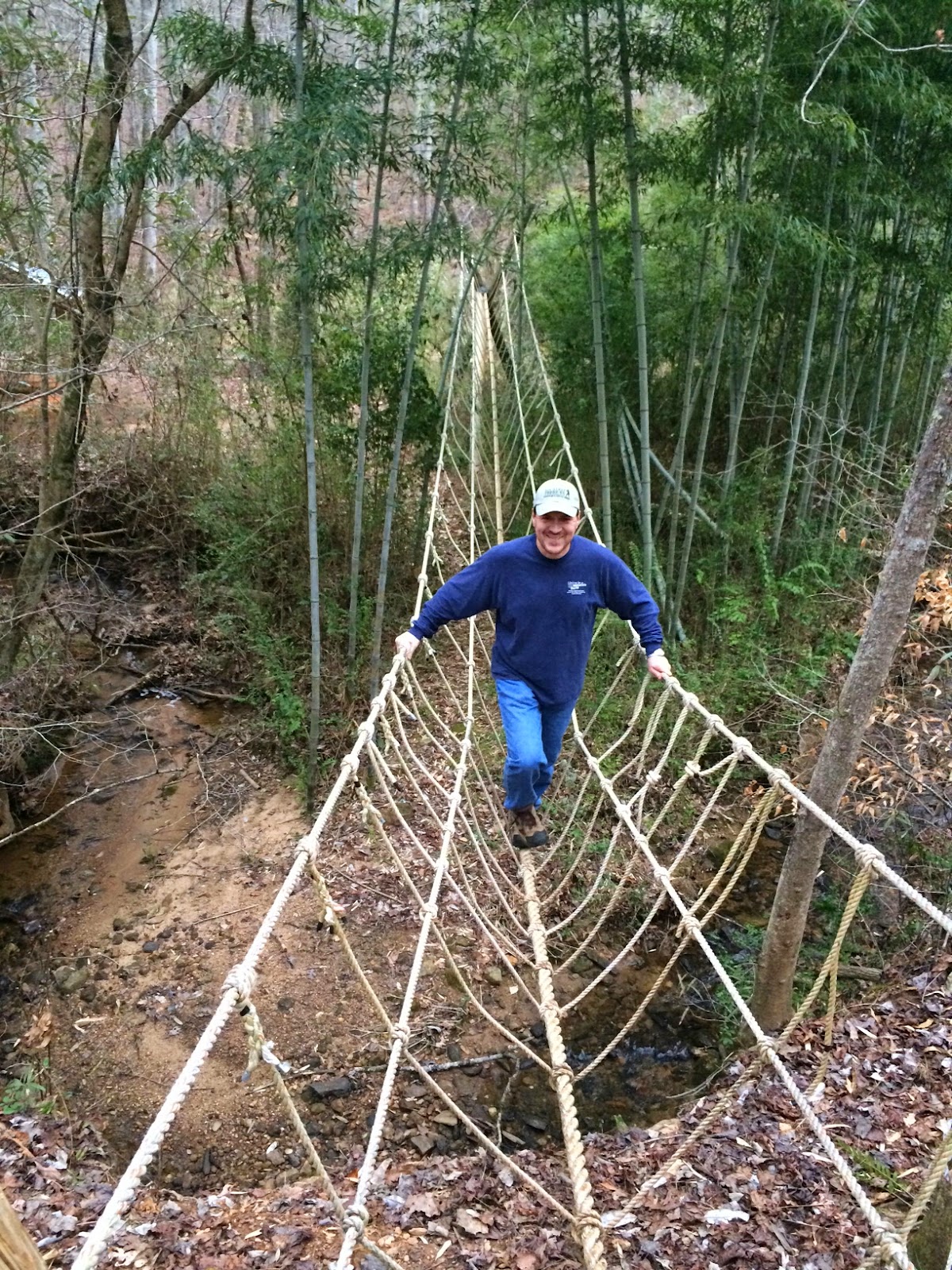
Chartered Organization Representative
Michael Tullier is the last to cross the
Global Village rope bridge as part of the
tour of countries.
At the troop's monthly Patrol Leaders' Council, the troop's youth leaders gave the campout high marks to learning about cultures and ways of living in developing countries; using new "appropriate technologies" such as rocket stoves; getting to be adventurous on the SIFAT creek crossing and rope bridge; learning and trying new things; and sharpening our compass-use skills. The youth leadership hoped to see greater attention at future events to everyone's ability to listen better to instructions, be responsible for their personal belongings, and be productive during activities such as meal prep.

For more photos from the troop's SIFAT outing, visit the troop's online photo album.

Saturday, February 14, 2015

Loving the less fortunate on Valentine's Day

On Saturday, Feb. 14, 1,544 pounds of Troop 50 Scouts reported to the Food Bank of East Alabama to assist its staff and other volunteers with processing the nearly 10,000 pounds of donated food that moved through the warehouse in four hours — and at least one pair of hands belonging to Troop 50 Scouts, leaders and parents touched just about every pound!. As early as 9 a.m., the Food Bank's warehouse was a flurry of activity with the deliveries of donated food from Saugahatchee District's annual Scouting for Food drive, and the quarterly, neighborhood-based food-collection drives that are part of the Food Bank's "Food Project of East Alabama."

Until the arrival of cars, trucks, and vans loaded with food began arriving, the troop assisted with a variety of repacking, stacking, and sorting needs the Food Bank staff had prepared for the troop. Scouts assisted with assembling boxes that would later contain the food the Food Bank provides to its member agencies such as church food pantries, shelters, and feeding programs, which in turn distribute this donated food to the needy — or food insecure — in our community. The troop also assisted with reboxing various food products, and organizing a large donation of bottled mustard items onto numerous pallets.

As the 6,853 pounds of Scouting for Food donations and 2,696 pounds of Food Project deliveries arrived, Scouts shifted gears by helping to sort the large volumes of food into categories that included canned items, plastic items, and items packaged in cardboard, glass and other packaging. Scouts first assisted with unloading cars, wheeling sorting bins into the Food Bank warehouse to be weighed, and then moving the bins into position to be sorted. In some cases, one bin was totally sorted before the next bin even made its way into the warehouse.
Thanks to the more than 25 Scouts, leaders and parents who assisted at some point during the morning Saturday with what has become an annual troop service project. Check out the troop's online photo album for more pictures from our morning of service.